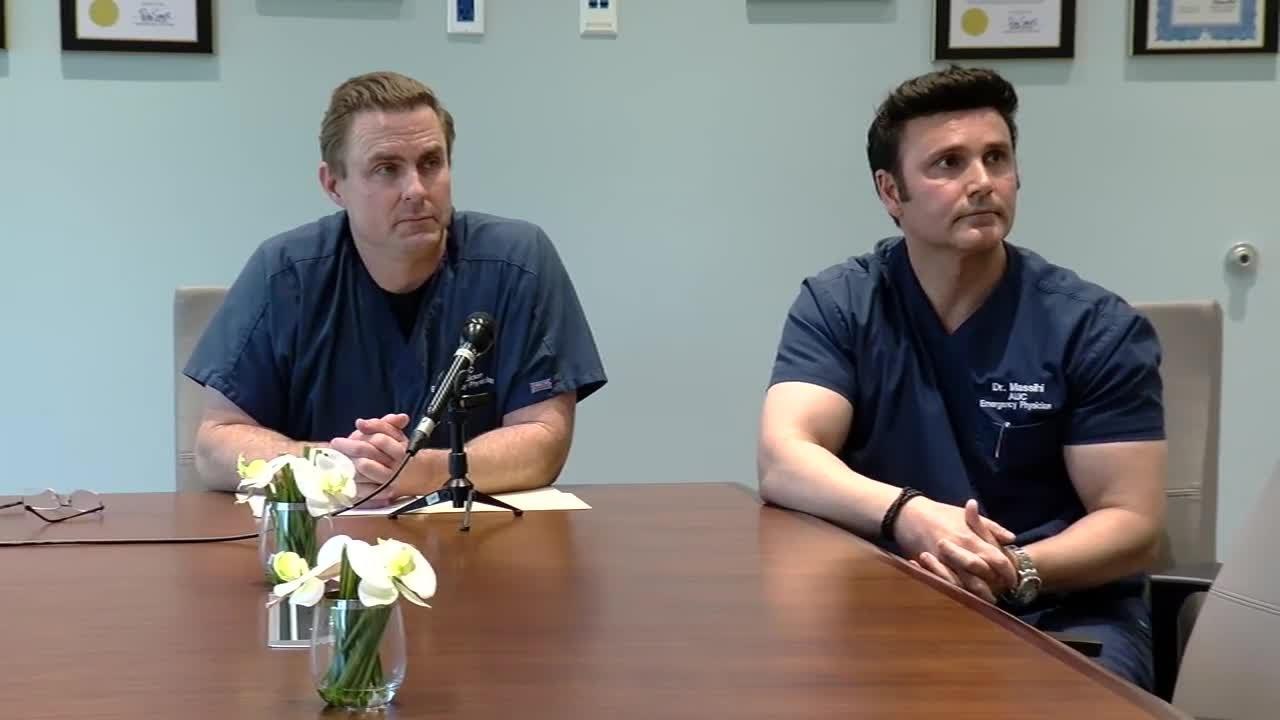
Here are some selected quotes from their interview with a hostile reporter (emphasis added).
We’d like to look at how we’ve responded as a nation, and why you responded. Our first initial response two months ago was a little bit of fear: [the government] decided to shut down travel to and from China. These are good ideas when you don’t have any facts. [Governments] decided to keep people at home and isolate them. Typically you quarantine the sick. When someone has measles you quarantine them. We’ve never seen where we quarantine the healthy.
So that’s kind of how we started. We don’t know what’s going on, we see this new virus. How should we respond? So we did that initially, and over the last couple months we’ve gained a lot of data typically. We’re going to go over the numbers a little bit to kind of help you see how widespread COVID is, and see how we should be responding to it based on its prevalence throughout society—or the existence of the cases that we already know about….
So if you look at California—these numbers are from yesterday—we have 33,865 COVID cases, out of a total of 280,900 total tested. That’s 12% of Californians were positive for COVID. So we don’t, the initial—as you guys know, the initial models were woefully inaccurate. They predicted millions of cases of death – not of prevalence or incidence – but death.
That is not materializing. What is materializing is, in the state of California is 12% positives.
You have a 0.03% chance of dying from COVID in the state of California. Does that necessitate sheltering in place? Does that necessitate shutting down medical systems? Does that necessitate people being out of work?
96% of people in California who get COVID would recover, with almost no significant sequelae; or no significant continuing medical problems. Two months ago we didn’t know this. The more you test, the more positives you get. The prevalence number goes up, and the death rate stays the same. So [the death rate] gets smaller and smaller and smaller. And as we move through this data—what I want you to see is—millions of cases, small death. Millions of cases, small death.
We extrapolate data, we test people, and then we extrapolate for the entire community based on the numbers. The initial models were so inaccurate they’re not even correct. And some of them were based on social distancing and still predicted hundreds of thousands of deaths, which has been inaccurate. In New York the ones they tested they found 39% positive. So if they tested the whole state would we indeed have 7.5 million cases? We don’t know; we will never test the entire state. So we extrapolate out; we use the data we have because it’s the most we have versus a predictive model that has been nowhere in the ballpark of accurate. How many deaths do they have? 19,410 out of 19 million people, which is a 0.1% chance of dying from COVID in the state of New York. If you are indeed diagnosed with COVID-19, 92% of you will recover.
We’ve tested over 4 million… which gives us a 19.6% positive out of those who are tested for COVID-19. So if this is a typical extrapolation 328 million people times 19.6 is 64 million. That’s a significant amount of people with COVID; it’s similar to the flu. If you study the numbers in 2017 and 2018 we had 50 to 60 million with the flu. And we had a similar death rate in the deaths the United States were 43,545—similar to the flu of 2017-2018. We always have between 37,000 and 60,000 deaths in the United States, every single year. No pandemic talk. No shelter-in-place. No shutting down businesses…
We do thousands of flu tests every year. We don’t report every one, because the flu is ubiquitous and to that note we have a flu vaccine. How many people even get the flu vaccine? The flu is dangerous, it kills people. Just because you have a vaccine doesn’t mean it’s gonna be everywhere and it doesn’t mean everyone’s going to take it… I would say probably 50% of the public doesn’t even want it. Just because you have a vaccine—unless you forced it on the public—doesn’t mean they’re going to take it.
Norway has locked down; Sweden does not have lock down. What happened in those two countries? Are they vastly different? Did Sweden have a massive outbreak of cases? Did Norway have nothing? Let’s look at the numbers. Sweden has 15,322 cases of COVID—21% of all those tested came out positive for COVID. What’s the population of Sweden? About 10.4 million. So if we extrapolate out the data about 2 million cases of COVID in Sweden. They did a little bit of social distancing; they would wear masks and separate; they went to schools; stores were open. They were almost about their normal daily life with a little bit of social distancing. They had how many deaths? 1,765. California’s had 1,220 with isolation. No isolation: 1,765. We have more people. Norway: its next-door neighbor. These are two Scandinavian nations; we can compare them as they are similar. 4.9% of all COVID tests were positive in Norway. Population of Norway: 5.4 million. So if we extrapolate the data, as we’ve been doing, which is the best we can do at this point, they have about 1.3 million cases. Now their deaths as a total number, were 182. So you have a 0.003 chance of death as a citizen of Norway and a 97% recovery. Their numbers are a little bit better. Does it necessitate shutdown, loss of jobs, destruction of the oil company, furloughing doctors?
I wanted to talk about the effects of COVID-19, the secondary effects. COVID-19 is one aspect of our health sector. What has it caused to have us be involved in social isolation? What does it cause that we are seeing the community respond to? Child molestation is increasing at a severe rate. We could go over multiple cases of children who have been molested due to angry family members who are intoxicated, who are home, who have no paycheck. Spousal abuse: we are seeing people coming in here with black eyes and cuts on their face. It’s an obvious abuse of case. These are things that will affect them for a lifetime, not for a season. Alcoholism, anxiety, depression, suicide. Suicide is spiking; education is dropped off; economic collapse. Medical industry we’re all suffering because our staff isn’t here and we have no volume. We have clinics from Fresno to San Diego and these things are spiking in our community. These things will affect people for a lifetime, not for a season.
I’d like to go over some basic things about how the immune system functions so people have a good understanding. The immune system is built by exposure to antigens: viruses, bacteria. When you’re a little child crawling on the ground, putting stuff in your mouth, viruses and bacteria come in. You form an antigen antibody complex. You form IgG IgM. This is how your immune system is built. You don’t take a small child put them in bubble wrap in a room and say, “go have a healthy immune system.”
This is immunology, microbiology 101. This is the basis of what we’ve known for years. When you take human beings and you say, “go into your house, clean all your counters—Lysol them down you’re gonna kill 99% of viruses and bacteria; wear a mask; don’t go outside,” what does it do to our immune system? Our immune system is used to touching. We share bacteria. Staphylococcus, streptococcal, bacteria, viruses.
Sheltering in place decreases your immune system. And then as we all come out of shelter in place with a lower immune system and start trading viruses, bacteria—what do you think is going to happen? Disease is going to spike. And then you’ve got diseases spike—amongst a hospital system with furloughed doctors and nurses. This is not the combination we want to set up for a healthy society. It doesn’t make any sense.
…Did we respond appropriately? Initially the response, fine shut it down, but as the data comes across—and we say now, wait a second, we’ve never, ever responded like this in the history of the country why are we doing this now? Any time you have something new in the community medical community it sparks fear—and I would have done what Dr. Fauci did—so we both would have initially. Because the first thing you do is, you want to make sure you limit liability—and deaths—and I think what they did was brilliant, initially. But you know, looking at theories and models—which is what these folks use—is very different than the way the actual virus presents itself throughout communities….